
By: Ben Strickland, Fall Marketing Intern
Downtown Jacksonville has a rich, powerful history filled with highlights that surpass the Bank of America Tower and low-lights deeper than the St. Johns River. The community has grown strong and proud through music, sport, and civil justice. I’ve taken on the mission of learning Jacksonville’s history so I can better appreciate the city that I live in.
Downtown Jacksonville stands tall along the bank of the St. John’s River and is only a few miles away from the Atlantic Ocean. The many bridges along the bank fortify the connections between the city and its people. After centuries of history, Downtown shows hints of its origins if you look hard enough.
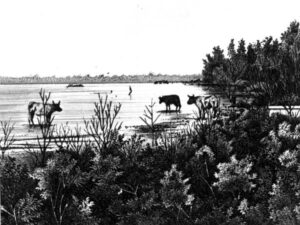
Before Jacksonville was named after President Andrew Jackson, it was a natural crossing point near the bank of the St. Johns River, where Native Americans would use it when herding cattle. When the British discovered the area, it was named “Cow Ford.” This site, near what is now Market Street, was later used as the start of Duval County in 1822.

In 1919, construction started for the St. Johns River Bridge, now called the Acosta Bridge. It is the first bridge built for automobiles in Jacksonville to cross the St. Johns River. St. Elmo “Chic” Acosta created the idea of providing forms of crossing the river outside of ferries. It was the first vertical bridge in Florida, which was notorious for getting stuck in the up position, earning the nickname “Yellow Monster.”

James Weldon Johnson Park was established in 1866, making it the city’s first and oldest park. It’s been known under several names over the years and was the center of several cultural and political events, including many civil rights demonstrations, such as several sit ins and Ax Handle Saturday, which followed those demonstrations. The park is named after an influential teacher, musician, writer, lawyer, and civil rights activist, James Weldon Johnson.

The Historic Federal Reserve building on Hogan Street was designed by Georgia and Jacksonville’s first female architect. Henrietta Dozier used aliases such as “H.C.” or “Harry” Dozier to hide the fact that she was a woman. She also had a hand in other Prairie-style buildings in North Florida and Georgia, including the St. Philips Episcopal Church on Pearl and Union and 2215 River Boulevard. where Deas Law Firm resides.
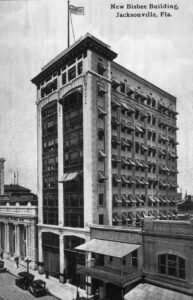
As one of Florida’s first and Jacksonville’s oldest high-rise buildings, the Bisbee Building was built in 1908 as a race against two other skyscraper buildings in the state Florida to be the tallest at the time. It is part of the Laura Trio along with the Old Florida National Bank and Florida Life building. These three buildings were significant as part of the renovations after the Great Fire of 1901, showcasing the Prairie-style architecture climbing in popularity in the 1900s-1910s.
This is only the foundation of what makes Downtown Jacksonville so special to the many people that visit and reside in DTJax. We celebrate and we build each other up despite the obstacles. Follow along with me on this journey to deepen our appreciation for this place we call home!