

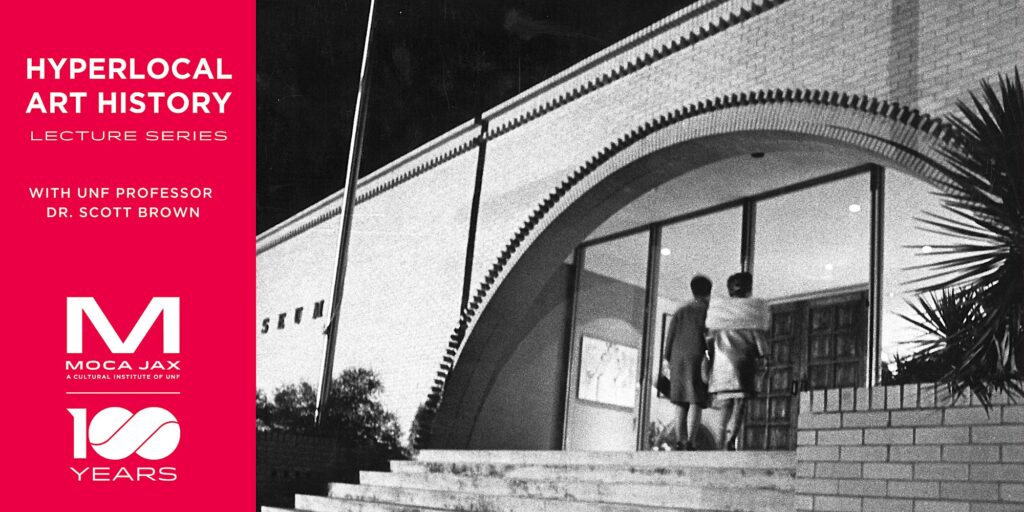
MOCA Jacksonville: Hyperlocal Art History
January 17, 2024 @ 5:30 pm - 6:30 pm
- 333 N Laura St Jacksonville, FL 32202 United States
- Visit Website
About
In the 100th anniversary year of MOCA Jacksonville, MOCA will host a series of talks by UNF Professor of Art History, Dr. Scott Brown, that rethinks the history of art from a standpoint here in North Florida. North Florida is the site of both ancient Indigenous cultures and of the oldest European settlements in continental North America, Fort Caroline and St. Augustine. Fort Caroline was briefly home to Jacques LeMoyne de Morgue, perhaps the first “American” artist, whose paintings of the First Coast, engraved by Theodor de Bry in the 1580s are among the earliest works of “American” art.
The Castillo San Marcos in St. Augustine is among the oldest masonry-built structures in North America and one of the most visited historic sites in the South. Between 1870 and 1930, when North Florida was America’s winter resort, practically every major American artist lived at least briefly and painted in Jacksonville-St. Augustine, among others, Winslow Homer, Martin Johnson Heade, Louis Comfort Tiffany, and John Singer Sargent. Jacksonville was a cradle of the motion picture industry, and strange but true, perhaps the most important art exhibition in America in 1924 was a show in Jacksonville. In March 1924, the Women’s Club and the Jacksonville Fine Art Society, the precursor to MOCA, organized a groundbreaking exhibition of Modern art, the first such show in the American South, featuring nearly 80 of the era’s leading avantgarde artists, including Marsden Hartley, Joseph Stella, Pablo Picasso, and Diego Rivera, among others.
The women who organized and sponsored the show caused a sensation in the city of Jacksonville. Debates about the nature of art, the definition of beauty, and future of Jacksonville played out in the papers and in public life for weeks before and after the exhibition. Across 500 years of art history as seen from here in North Florida, the same important questions echo from the Renaissance to the present in our Jacksonville today.
1/17 – Putting Jacksonville on the Map: Visualizing the First Coast from Fort Caroline to the Fine Arts Society
2/7 – When North Florida was the Center of the Art World: Moran, Homer, Heade, and the Birth of Florida Art
2/21 – The Women’s Movement and the Development of Art in Early Florida: Merrydelle Hoyt and the Founders of the Jacksonville Fine Arts Society
3/6 – The Art and Ideas of Our Time: The 1924 Woman’s Club Exhibition and the Origins of MOCA Jacksonville

ABOUT SPEAKER
Peter Scott Brown, PhD, is an associate professor of medieval art history at the University of North Florida. He has a bachelor’s degree from Bard College in Annandale-on-Hudson, New York, and master’s and doctorate degrees in art history from Yale University. Brown is a specialist in medieval art history with particular focuses on Romanesque sculpture and the liturgical and popular receptions of medieval art. His research and publications address topics including the origins of medieval architectural sculpture, architectural sculpture and liturgy, spolia in medieval art, epigraphy in medieval sculpture, the restoration of medieval sculpture, and iconographies of women and the profane. Brown joined the faculty of the University of North Florida in 2005 and teaches widely on the critical interpretation of art and on the art of the Middle Ages and early modern period in courses including art appreciation, medieval art and architecture, Romanesque art, northern Renaissance and northern baroque art, and the apocalypse in art. He has served on MOCA Jacksonville’s Board of Trustees since 2015.